

“AI memory” gets marketed as a convenience feature — the assistant remembers your preferences so you don’t repeat yourself. What gets left out of the pitch is that persistent memory is also a persistent attack surface, and understanding why is the difference between adopting a genuinely useful feature and quietly accepting a risk nobody explained.
Why Persistent Memory Changes the Threat Model
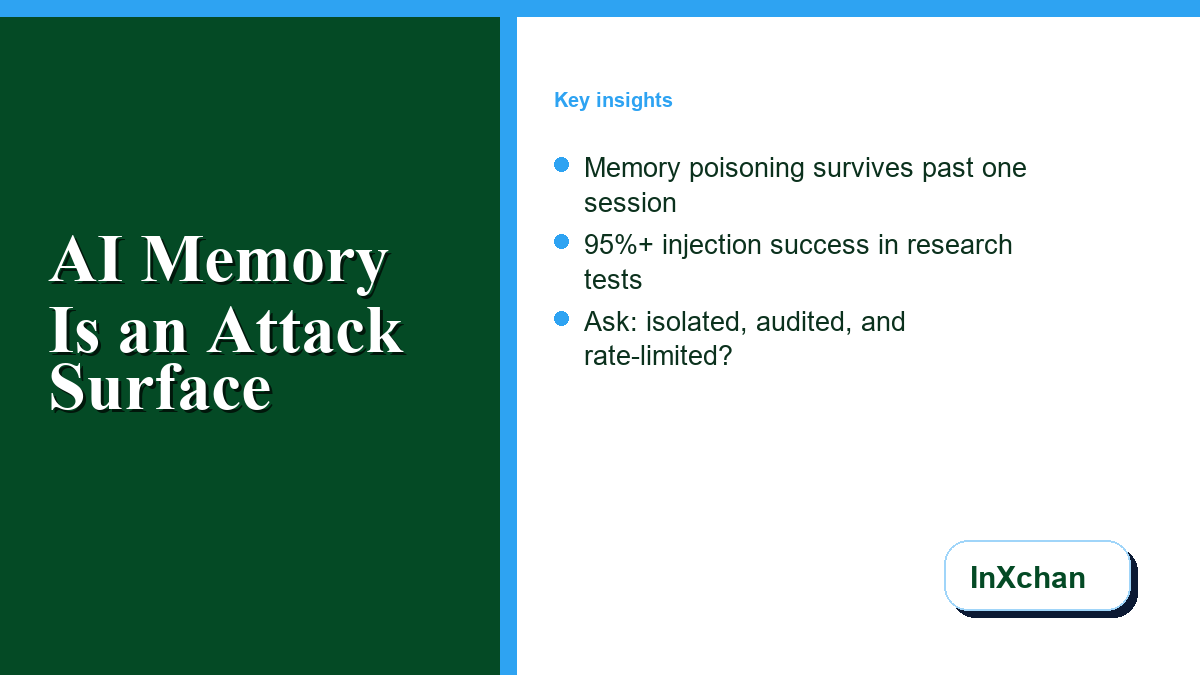
A normal prompt injection attack against an AI system typically dies when the session ends — the malicious instruction was embedded in that one conversation and disappears with it. Memory poisoning is different: it targets the assistant’s long-term memory layer specifically, so a malicious or misleading entry can survive across sessions and get trusted as legitimate context in unrelated future tasks. Once an attacker gets false information treated as trusted memory, they’ve gained a foothold inside the system’s decision-making that a single-session attack never achieves.
How This Actually Gets Exploited
Research has demonstrated memory injection attacks that succeed through nothing more exotic than regular, seemingly normal queries — no obvious malicious payload required, just carefully crafted input that gets stored as if it were legitimate user context. Once poisoned entries sit in memory, they can be retrieved and trusted in contexts the original attacker never directly touched, turning one successful injection into leverage across an ongoing relationship with the system.
What Responsible Memory Design Actually Requires
Security guidance for AI agent memory systems converges on a consistent set of practices: sanitize data before it’s ever stored, isolate memory between different users and sessions so one person’s poisoned entry can’t bleed into another’s, set expiration and size limits so old or unused entries don’t accumulate indefinitely, audit stored content for sensitive data before it persists, and use integrity checks on long-term memory so tampering is detectable rather than invisible.
Questions Worth Asking Before Trusting a Memory-Enabled Tool
- Is memory isolated per user and per session, or is there any cross-contamination risk?
- Can stored memory be reviewed and audited, or is it an opaque store nobody can inspect?
- Are there size and expiration limits, or does everything persist indefinitely by default?
- Is there any integrity verification on stored entries, or is anything written to memory implicitly trusted later?
A platform that treats memory architecture as a security surface — not just a UX convenience — builds these controls in rather than bolting them on after a documented incident. Charigent’s approach to structured, reviewable memory is worth evaluating specifically on this axis, not just on how convenient the recall feature feels.
The Bottom Line
Persistent memory is a real capability worth having — and a real attack surface worth asking about directly before trusting it with anything sensitive. The two facts don’t cancel each other out; they just mean the feature deserves the same scrutiny any other place your data lives would get.


0 Comments